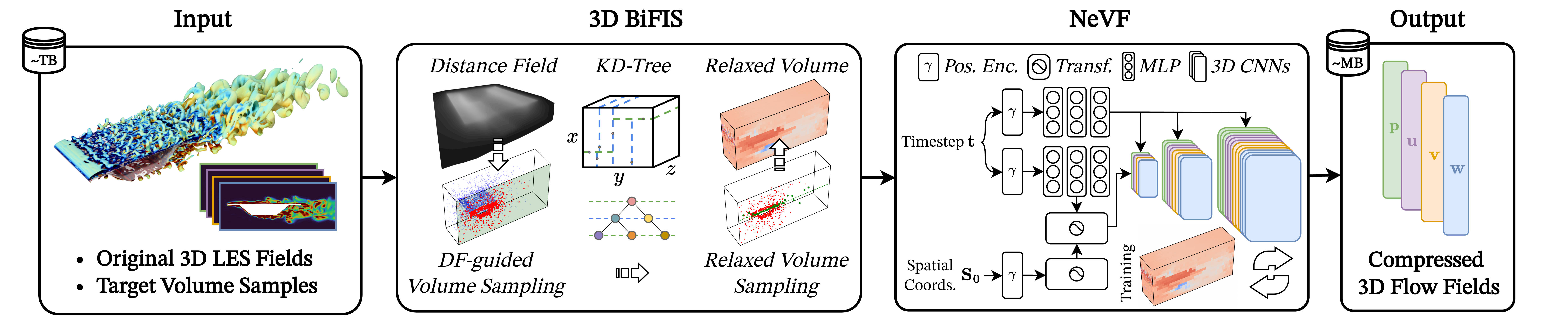
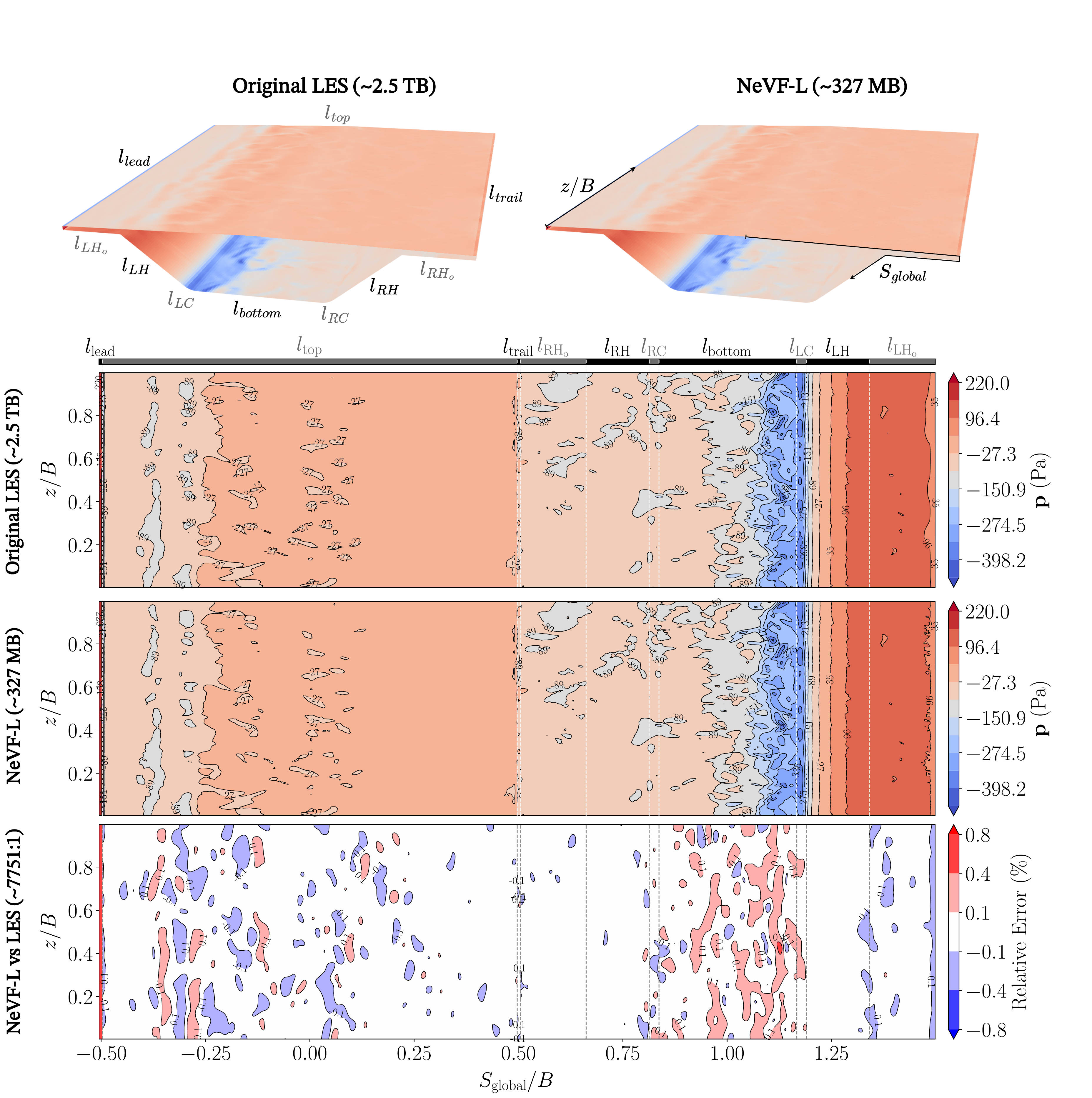
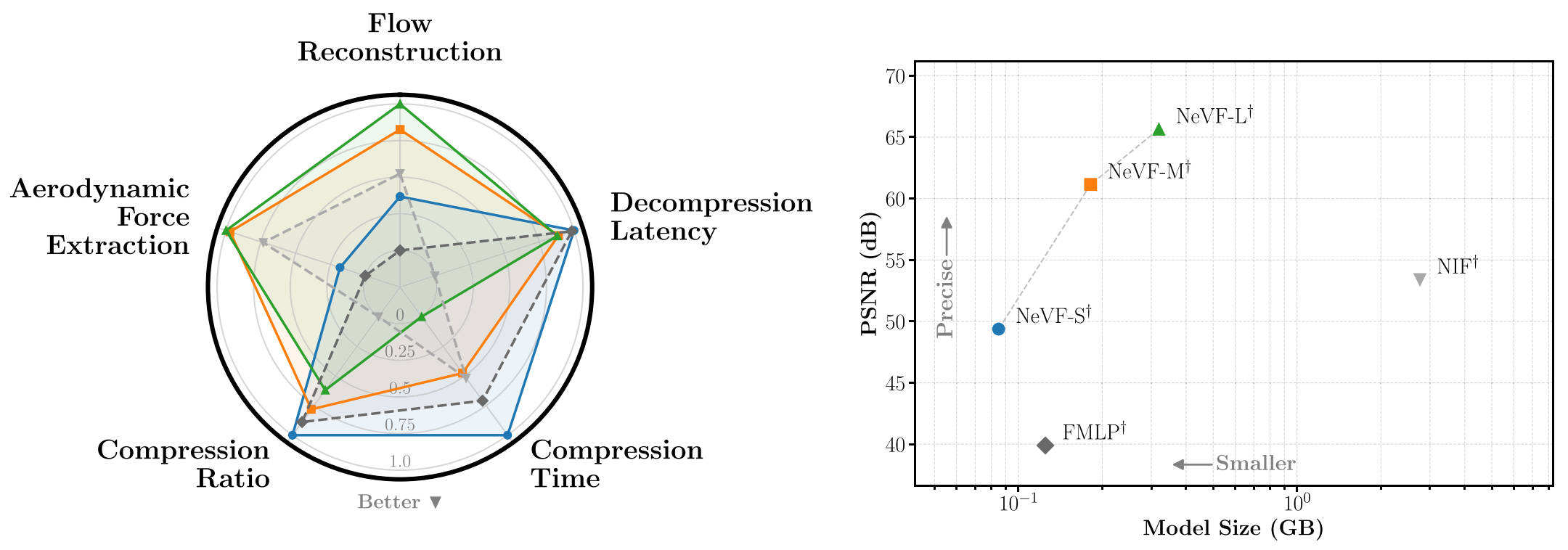
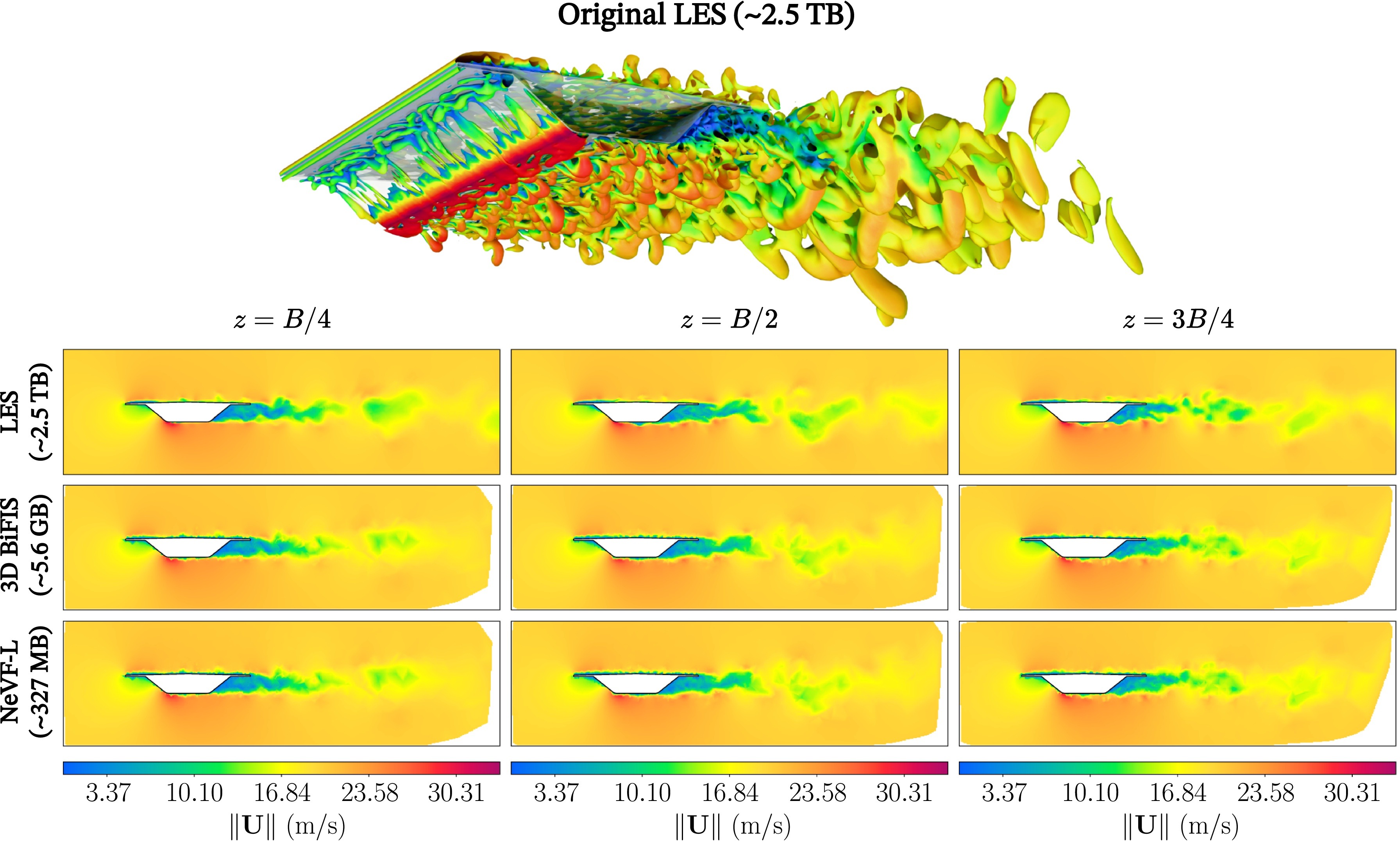
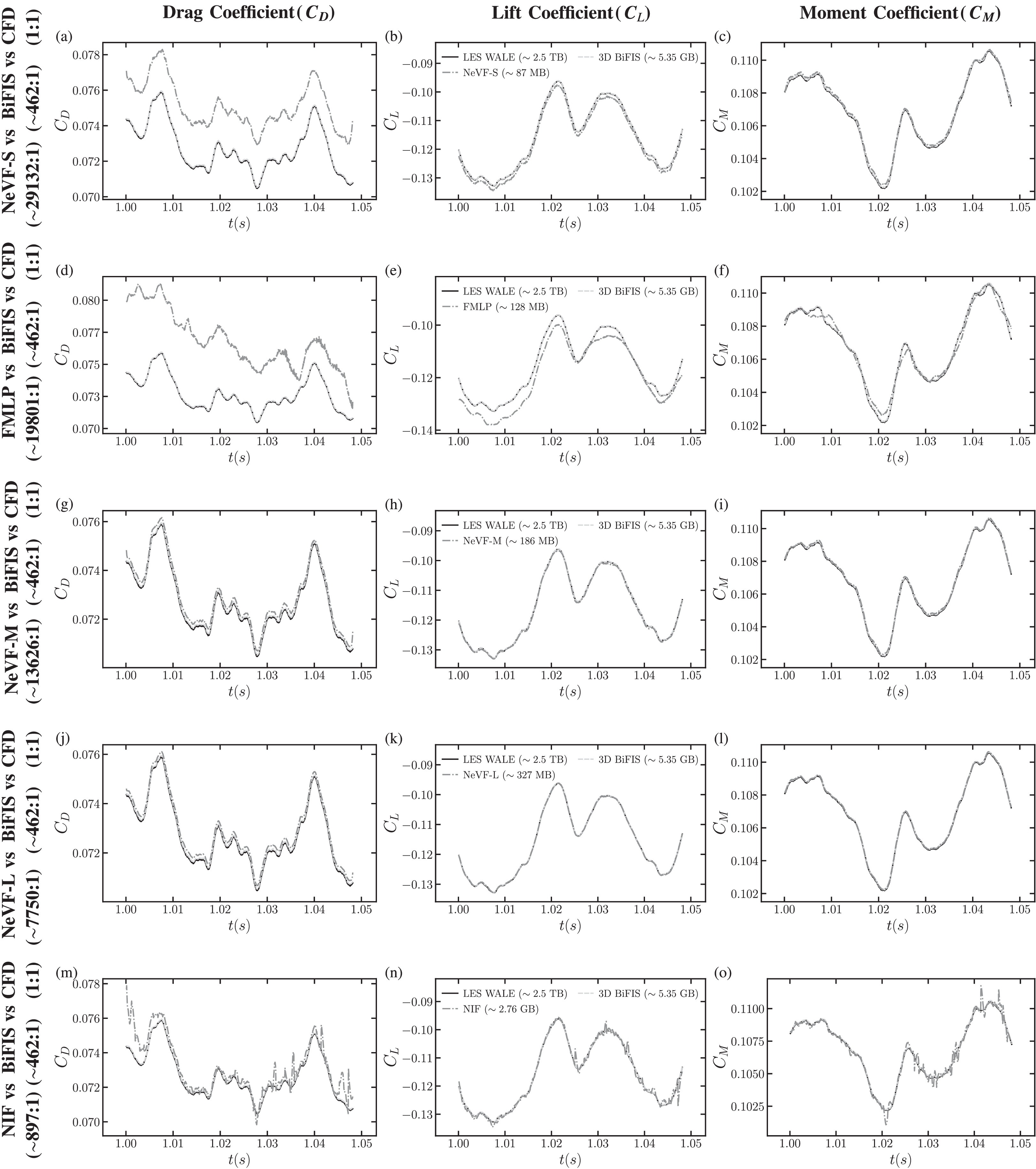
Computational Fluid Dynamics (CFD) simulations of civil engineering aerodynamics, which are commonly characterized by complex three-dimensional flow fields, generate massive spatiotemporal datasets, creating significant storage and computational bottlenecks that heavily constrain iterative engineering workflows. To overcome these challenges, this paper presents a novel two-stage compression framework that models three-dimensional flow field data using Neural Flow Volume Fields (NeVF). The first stage employs a distance field-biased flow importance sampling (3D BiFIS) strategy to reduce data dimensionality intelligently; this approach selectively extracts key near-wall flow information, guided by surface proximity to construct a “relaxed” image volume. Subsequently, a deep network, leveraging positional encodings and disentangled spatio-temporal attention mechanisms, highly compresses this volumetric representation. The effectiveness of the resulting flow field representation is evaluated using a comprehensive 3D Large-Eddy Simulation (LES) dataset of a bluff single-box bridge deck, characterized by complex, uncorrelated spanwise flow features. Results demonstrate high data compression rates of 7000:1 to 30000:1 while preserving high-fidelity near-body aerodynamic flow features, enabling accurate estimation of wind-induced forces. Ultimately, our methodology streamlines efficient storage, reconstruction, and rapid analysis of exascale CFD datasets, unlocking potential new applications for deep learning emulation and data-intensive tasks, such as, uncertainty quantification and flow-driven aero-structural optimization.
@Article{mures2026nevf,
  author = {Mures, Omar A. and Cid Montoya, Miguel},
  title = {{NeVF: Representing CFD} simulations as neural flow volume fields for efficient compression, reconstruction, and analysis},
  journal = {Computer-Aided Civil and Infrastructure Engineering},
  volume = {49},
  pages = {100125},
  year = {2026},
  doi = {10.1016/j.cacaie.2026.100125},
  url = {https://doi.org/10.1016/j.cacaie.2026.100125},
}